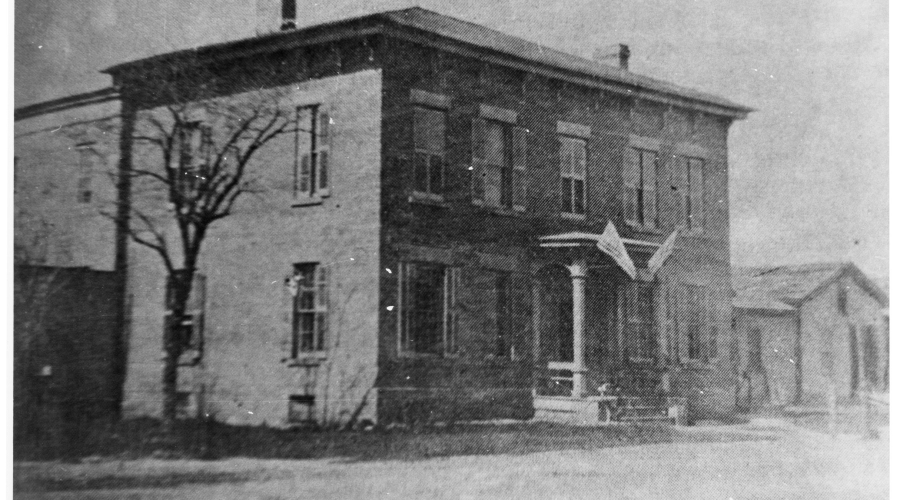


ROCK COUNTY, WI — Rock County’s courts were born in a stagecoach inn. When the first territorial court met in Janesville in April 1839, there was no courthouse, so the judge held court in an unfinished hall at the Janesville Stage House. The county’s criminal history began there: small at first, and then, in 1855, with the darkest day in the county’s legal history.
The first criminal case: too much whiskey, $10 fine
The first case on Rock County’s criminal docket was United States vs. Thomas Sidwell. Sidwell was charged with selling liquor in quantities of more than one quart, which territorial law forbade. He pleaded guilty and was fined $10.
The judges of that era were colorful. Justice David Irwin, the first judge to serve Rock County, was remembered for adjourning court at a moment’s notice to go hunting. He once reportedly told a jury, “it is a matter of indifference to me how you bring in your verdict,” then dismissed them five minutes later when they hadn’t agreed. He also reportedly said his horse, Pedro, “had more sense than any lawyer in his court.”
The first homicide trial
Rock County’s first homicide trial after statehood grew out of a farm dispute. John S. Godfrey’s animals had reportedly trespassed on the land of his relative, Samuel Godfrey. The two argued, and Samuel struck John with a club, killing him. At trial Samuel Godfrey claimed self-defense. The jury found him not guilty, a verdict the historical record says “reportedly met with general favor.”
1855: Rock County’s first and only lynching
Andrew Alger was a Beloit lumberman with a crew cutting timber north of Janesville. They floated logs down the Rock River to Beloit. In 1855 Alger was traveling the Rock River Road by buggy with his crew’s payroll when he was attacked and killed by David F. Mayberry, a man who had already served prison time in Illinois for horse theft.
Mayberry was caught quickly. At his trial in Janesville, before Judge James R. Doolittle, the jury deliberated for about 20 minutes before finding him guilty.
Outside, the mood was ugly. Alger’s workers had lost their pay and, by contemporary accounts, genuinely cared for their employer. They gathered around the courthouse and threatened to hang Mayberry. Wisconsin had abolished the death penalty in 1853, and the crowd knew the most he could get was life in prison.
That is what he got: life at hard labor, with set days each year in solitary confinement on bread and water. As he was being taken from the courthouse to the jail, a crowd seized him, took him to the bottom of the hill, on what is now South Main Street in Janesville, and hanged him from a tree. A contemporary account describes the scene as a stain “which time can never obliterate.” The next day the sheriff personally cut the tree down, because residents had started cutting it up for souvenirs.
Judge Doolittle resigned the next year. He was later elected to the U.S. Senate and served through the Civil War.
The courthouse that burned
Four years after the lynching, in 1859, Rock County’s first courthouse, a two-story frame building on the hill where the courthouse still stands, was destroyed by fire. For more than a decade the county had no courtroom, and its circuit court held sessions in neighboring counties until a new courthouse was finished in 1870.
To today
The county’s courts now sit in the courthouse complex at 51 South Main Street in Janesville, built in 1957 and expanded in 1999, a few steps from where the crowd took David Mayberry. Today the most serious cases there are measured, documented and argued for months, like the Rock County poisoning case still awaiting trial. The 1855 crowd is the reason the rule of the courtroom matters.
Source: Court History of Rock County, Wisconsin, 1836 to 2010, prepared for the Beloit Historical Society by Attorney William A. Bolgrien, citing the 1879 History of Rock County and the History of the Bench and Bar of Wisconsin (1898).
